

Filter
Blogs
26 results

Laboratoo Admin
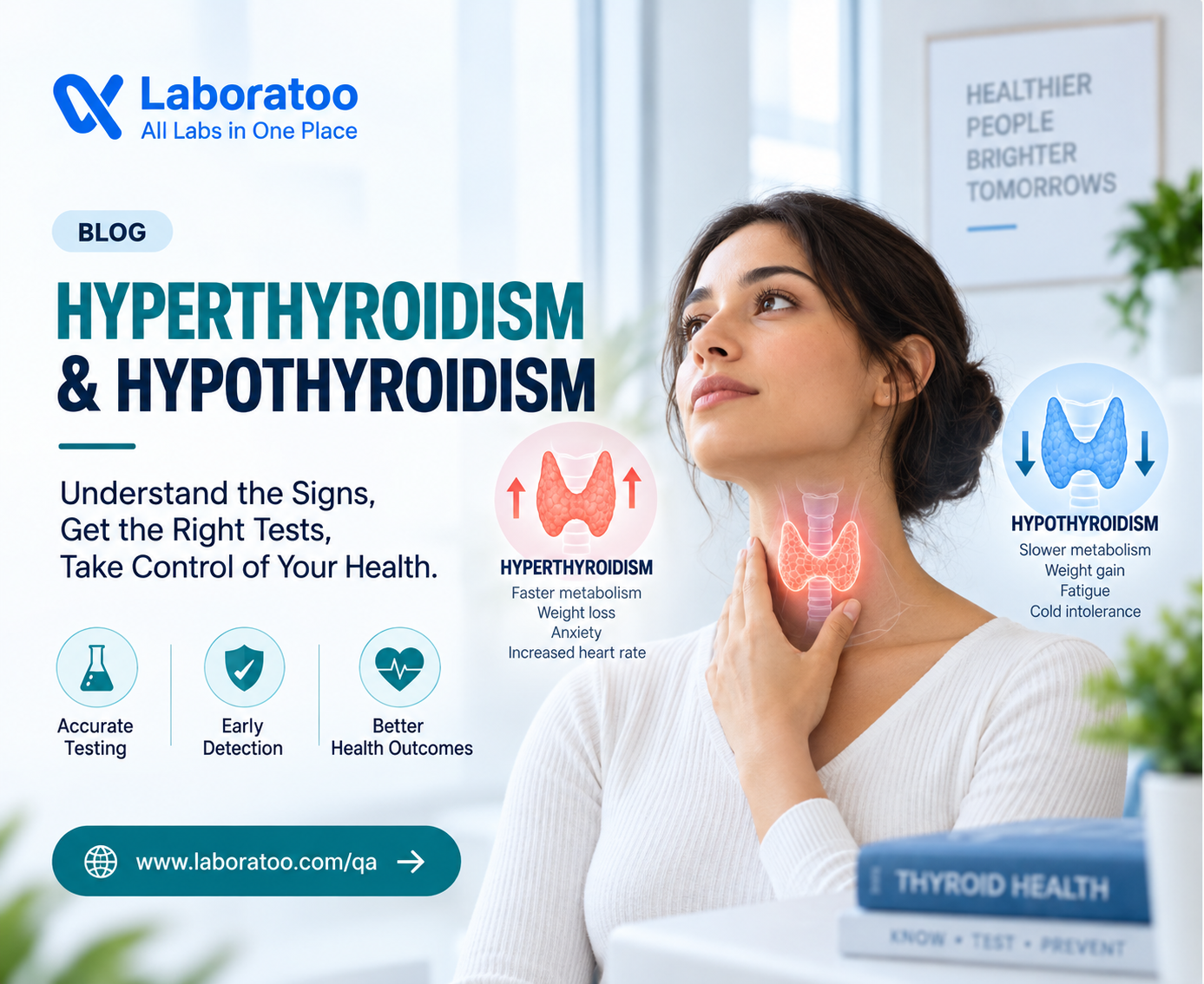
Hyperthyroidism vs Hypothyroidism: Symptoms, Causes, and Thyroid Tests
Your thyroid may be small, but it plays an important role in how your body functions. Located at the front of your neck, the thyroid gland produces hormones that help regulate metabolism, energy levels, heart rate, body temperature, and many other processes. When the thyroid produces too much or too little hormone, two common conditions can develop: hyperthyroidism and hypothyroidism. Understanding the difference—and getting the right thyroid blood tests—can help identify problems early. What Is Hyperthyroidism? Hyperthyroidism, also known as an overactive thyroid, occurs when the thyroid gland produces more thyroid hormones than your body needs. This can cause many body processes to speed up. Common symptoms may include: Unexplained weight loss despite a normal or increased appetite Rapid or irregular heartbeat Anxiety, nervousness, or irritability Increased sweating and sensitivity to heat Shaking or trembling hands Difficulty sleeping Muscle weakness Frequent bowel movements Fatigue One of the most common causes of hyperthyroidism is Graves’ disease, an autoimmune condition. Other causes can include thyroid nodules, thyroid inflammation, or certain medications. What Is Hypothyroidism? Hypothyroidism, or an underactive thyroid, occurs when the thyroid does not produce enough thyroid hormones. As a result, many processes in the body can slow down. Symptoms can develop gradually and may include: Fatigue or low energy Unexplained weight gain Feeling unusually cold Dry skin Constipation Muscle weakness or aches Difficulty concentrating Low mood Hair thinning Changes in menstrual periods Slower heart rate A common cause is Hashimoto’s thyroiditis, an autoimmune condition in which the immune system attacks the thyroid gland. Other possible causes include thyroid surgery, certain medications, iodine-related problems, and some medical treatments. Hyperthyroidism vs Hypothyroidism Although both conditions involve the same gland, they generally affect the body in opposite ways. With hyperthyroidism, metabolism tends to accelerate. A person may experience weight loss, heat intolerance, increased heart rate, sweating, and anxiety. With hypothyroidism, metabolism tends to slow. Weight gain, cold intolerance, tiredness, dry skin, and constipation are more common. However, symptoms alone cannot reliably diagnose a thyroid disorder. Many thyroid symptoms overlap with other health conditions, which is why laboratory testing is important. Which Blood Tests Check Thyroid Function? The first test commonly used to assess thyroid function is TSH (thyroid-stimulating hormone). Additional tests may include Free T4 (FT4) and Free T3 (FT3) to measure circulating thyroid hormones. In general, a low TSH with elevated thyroid hormones may suggest hyperthyroidism, while a high TSH with low thyroid hormone levels may suggest primary hypothyroidism. Results should always be interpreted in context by a qualified healthcare professional. Doctors may also request thyroid antibody tests, such as TPO antibodies or TSH receptor antibodies, when an autoimmune thyroid condition is suspected. When Should You Consider a Thyroid Test? Consider speaking with a healthcare professional if you have persistent unexplained fatigue, significant weight changes, heart-rate changes, unusual sensitivity to heat or cold, hair changes, menstrual irregularities, or other symptoms associated with thyroid dysfunction. Testing may also be recommended based on your medical history, medications, pregnancy status, family history, or previous thyroid results. Check Your Thyroid Health in Qatar A simple blood test can provide valuable information about how your thyroid is functioning. Through Laboratoo, you can compare and book thyroid blood tests and health packages from diagnostic providers in Qatar—all in one place. Know your symptoms. Get the right tests. Understand your health.
Laboratoo Admin
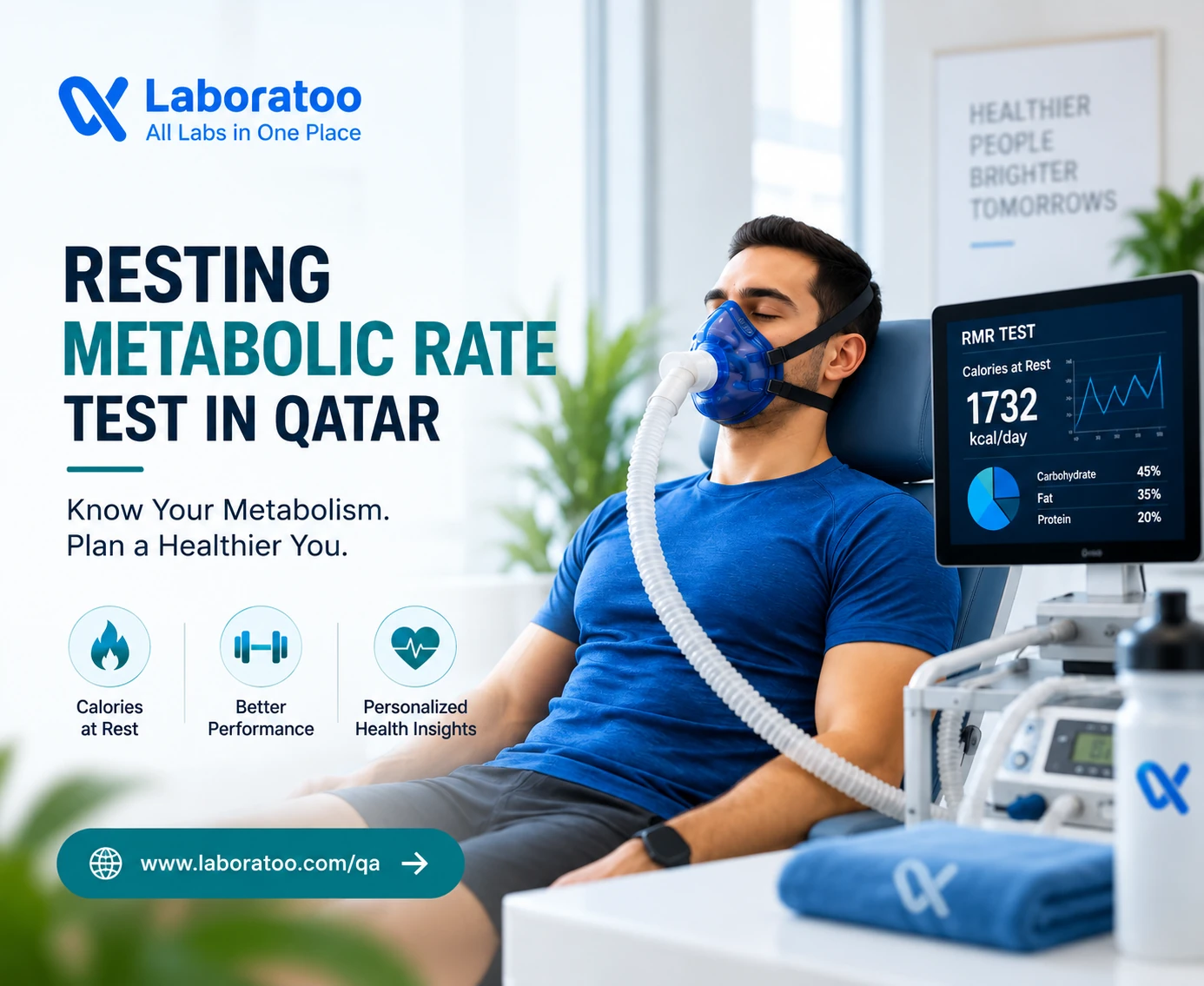
Resting Metabolic Rate Test in Qatar: Why Your Metabolism Matters More Than the Scale
If you're trying to lose weight, build muscle, improve athletic performance, or simply understand your body's energy needs, you may have come across calorie calculators and metabolism estimates.These calculators can provide a useful starting point, but they are based on equations and population averages. Your actual energy needs can vary depending on factors such as body composition, age, fitness level, muscle mass, training status, and other individual factors.A resting metabolic rate (RMR) test in Qatar can provide a more personalized measurement by assessing how much energy your body uses while you are at rest.What Is a Resting Metabolic Rate Test?Your resting metabolic rate, or RMR, is the amount of energy your body requires to maintain essential functions while you are resting.Even when you're not exercising, your body is continuously using energy for functions such as:BreathingBlood circulationMaintaining body temperatureSupporting organsCell maintenance and repairOther essential physiological processesFor many people, resting energy expenditure represents a substantial portion of their total daily energy expenditure. This is why understanding your individual resting metabolic rate can be useful when creating a nutrition, weight-management, or fitness plan.An RMR test typically uses indirect calorimetry. During the test, you breathe through a mask or mouthpiece while resting. The equipment measures gases involved in respiration, particularly oxygen consumption and carbon dioxide production, and uses this information to estimate your resting energy expenditure.Instead of relying only on a generic formula, the test provides a measurement based on your body's actual respiratory data under the test conditions.RMR Test vs. BMR: What's the Difference?RMR and BMR are closely related, but they are not exactly the same.Basal metabolic rate (BMR) refers to the energy your body requires under highly controlled basal conditions. BMR testing generally involves stricter preparation and testing conditions.Resting metabolic rate (RMR) is measured under less restrictive resting conditions and is commonly used in practical nutrition and fitness settings.You may also see a BMR estimate on a body-composition report, including reports generated by devices such as InBody. That figure is generally calculated using body-composition information and an equation.A dedicated RMR test, on the other hand, uses respiratory measurements to assess resting energy expenditure.For someone simply monitoring general fitness, an estimated BMR can be useful. For people who want more individualized information for nutrition or performance planning, an RMR measurement can provide additional insight.Why Does Your Resting Metabolic Rate Matter?Knowing your RMR doesn't automatically tell you exactly how many calories you should eat every day. However, it can provide an important starting point for understanding your overall energy requirements.1. Create a More Personalized Nutrition PlanGeneric calorie calculators use formulas based on factors such as age, height, weight, and sex.These estimates can be useful, but they don't directly measure your individual resting energy expenditure.An RMR test can give you a measured value that a qualified nutrition or fitness professional can consider when developing an appropriate nutrition strategy.2. Support Weight ManagementWhether your goal is weight loss, weight maintenance, or weight gain, understanding energy expenditure is important.If your calorie target is based entirely on a generic calculation, it may not accurately reflect your individual needs.RMR information can be combined with your activity level, exercise routine, body composition, and nutritional intake to develop a more personalized approach.3. Help With Weight-Loss PlateausA weight-loss plateau can happen for many reasons.Changes in activity, food intake, body composition, adherence to a nutrition plan, and metabolic adaptation can all play a role.If you've been consistently following a structured plan but aren't seeing the expected changes, an RMR assessment may provide additional information that can be discussed with a qualified healthcare, nutrition, or fitness professional.4. Support Sports PerformanceAthletes and serious fitness enthusiasts need to balance energy intake with training demands.An RMR test can be considered alongside other assessments such as:VO2 max testingBody composition analysisExercise performance testingLactate threshold testingFitness assessmentsTogether, these measurements can provide a broader picture of your energy requirements and physical performance.5. Track Changes Over TimeYour resting energy expenditure isn't necessarily fixed throughout your life.Factors such as changes in body composition, muscle mass, physical activity, age, and prolonged changes in energy intake can influence energy expenditure.When appropriate, repeated testing can help you and your professional team understand how your measurements change over time.Who Can Benefit From an RMR Test?A resting metabolic rate test in Qatar may be worth considering if you:Are following a structured weight-management programWant a more personalized starting point for calorie planningAre an athlete or regular fitness enthusiastAre preparing a nutrition plan around a demanding training scheduleHave experienced a weight-management plateauAre interested in understanding your energy expenditureWant to combine metabolic information with body-composition testingAn RMR test isn't necessary for everyone. A qualified healthcare, nutrition, or sports professional can help determine whether it is appropriate for your individual goals.How Is an RMR Test Performed?The process is generally simple and non-invasive.Depending on the testing facility and equipment used, you may be asked to:Rest quietly before the measurement.Sit or lie comfortably.Wear a mask or use a mouthpiece connected to the testing equipment.Breathe normally while the equipment measures respiratory gases.Remain relaxed and as still as possible during the measurement.Complete the test, which commonly takes around 20–30 minutes, depending on the equipment and provider.The exact procedure can vary between providers, so always follow the instructions given by the facility performing your test.How Should You Prepare for an RMR Test?Preparation can affect the measurement, so following your provider's instructions is important.Common preparation recommendations may include:Avoid eating for several hours before the test, often overnight.Avoid strenuous exercise before testing.Avoid caffeine before the assessment.Avoid nicotine before the test.Get a normal night's sleep.Arrive early enough to relax before the measurement.Avoid significant physical activity immediately before testing.Your testing provider may have specific preparation requirements. Always follow the provider's instructions, especially regarding fasting, medication, exercise, and other factors.RMR Test and InBody Test: Do You Need Both?An RMR test and an InBody or other body-composition assessment provide different types of information.An InBody/body-composition assessment can provide information about factors such as:Body weightBody-fat percentageSkeletal muscle massFat massBody composition distributionAn RMR test focuses on resting energy expenditure through respiratory measurements.Using both assessments can therefore provide complementary information.For example, body-composition testing can help you understand what your body is made of, while RMR testing can help assess how much energy your body uses at rest.RMR Test and VO2 Max: What's the Difference?RMR and VO2 max are also different assessments.RMR testing focuses on energy expenditure while resting.VO2 max testing measures your body's ability to use oxygen during intense exercise and is commonly used to assess aerobic fitness and endurance capacity.If you're interested in sports performance, these tests can complement each other:RMR → resting energy expenditureBody composition → body composition profileVO2 max → aerobic fitnessTogether, they can provide a more complete picture of your fitness and performance.Where Can You Get an RMR Test in Qatar?Availability of metabolic testing can vary between healthcare, sports-performance, wellness, and diagnostic providers.Instead of contacting multiple facilities individually, you can use Laboratoo to explore available testing options in Qatar.Laboratoo is a healthcare marketplace that helps users compare and book available laboratory, health screening, sports testing, and diagnostic services from participating providers.You can explore available RMR testing options in Qatar, check the available information, compare options, and book online where the service is available.Book a Resting Metabolic Rate Test in QatarIf you're serious about understanding your metabolism and building a more personalized fitness or nutrition plan, an RMR test can be a useful assessment to consider.Laboratoo helps you compare and book health and sports testing services in Qatar, making it easier to find suitable testing options without having to search through multiple providers individually.Explore available testing options and book through: Laboratoo QatarFinal ThoughtsYour metabolism is individual to you, and a number from a generic calorie calculator may not tell the whole story.A resting metabolic rate test in Qatar can provide a measured assessment of your resting energy expenditure and may be particularly useful for people working toward specific weight-management, nutrition, or sports-performance goals.RMR testing can be even more useful when considered alongside body-composition and fitness assessments such as InBody and VO2 max testing.If you're looking for a more personalized approach to understanding your energy needs, speak with a qualified professional and consider whether an RMR test is appropriate for your goals.

Laboratoo Admin
PCR Test Prices in Qatar — What to Expect & How to Book
PCR Test Prices in Qatar — What to Expect & How to BookMost PCR test prices you'll find online in Qatar date back to 2021, COVID swab rates that no longer reflect what clinical molecular testing actually costs today. At Laboratoo, we publish our PCR test prices upfront so you can plan before you book. Whether you've been referred by a doctor or you're booking independently, here's exactly what you need to know. What Is a PCR Test Used for in Qatar? PCR (Polymerase Chain Reaction) is a molecular laboratory technique that detects the DNA or RNA of a specific pathogen — confirming whether an infection is present, even at very low levels. It's the gold standard for diagnosing infections accurately. At Laboratoo's molecular biology department, we use PCR to test for: H. pylori — the stomach bacterium linked to ulcers and gastric cancer Tuberculosis (TB) — for definitive diagnosis or treatment monitoring Respiratory infections — influenza, RSV, bacterial pneumonia Sexually transmitted infections (STIs) — chlamydia, gonorrhoea, herpes (HSV) COVID-19 — when required for travel, employment, or clinical care PCR Test Prices at Laboratoo QatarTESTSample TypeH. pylori PCR (UBT)Stool / breathTB / Mycobacterium PCRSputum / bloodRespiratory panel PCRNasal swabSTI PCR paneUrine / swabCOVID-19 RT-PCRNasal swab View our full test menu for a complete list of available molecular tests. No referral required for most of our PCR tests — you can self-book online. Some specialist molecular panels may require a physician's request; our team will confirm at booking. Book Your PCR Test Online → How Is a PCR Test Different from a Standard Blood Test? It's a common question. A standard blood test — like a CRP or full blood count — measures your body's response to illness. It tells you how your body is reacting, but not always what is causing it. A PCR test detects the genetic material of the pathogen itself. It tells you precisely which infection is present, and whether it's active. This makes PCR the preferred method when a specific diagnosis is needed before starting treatment. How to Book a PCR Test at Laboratoo in Doha Book online or call us — use the Laboratoo booking system or contact our Doha clinic directly. Appointments are available 6 days a week.Prepare for your appointment — most PCR tests require no preparation. For H. pylori testing, avoid antibiotics and antacids for 2 weeks beforehand. Your confirmation email will include any test-specific instructions.Sample collection — a trained clinician collects your sample (nasal swab, stool, urine, or blood) in a sterile environment. The process takes 5–10 minutes.Receive your results — results are delivered securely by SMS and email, within 24–72 hours depending on the test. No need to return to the clinic to collect them. Book Your PCR Test Online → Book Your PCR Test in Qatar Today Laboratoo is Qatar's trusted accredited diagnostic laboratory for molecular and clinical testing. All PCR tests are processed in our accredited Doha facility by qualified laboratory scientists, and results are delivered securely, directly to you. We publish our prices transparently, accept most major insurance plans, and offer online booking with results by SMS. No hidden costs. No unnecessary waiting.
Laboratoo Admin
TSH Test in Doha: What It Checks and When You Should Get One
Feeling wiped out for weeks with no real explanation? Putting on weight even though nothing about your routine has changed? It's tempting to blame the heat, work stress, or just getting older, and sometimes that really is all it is. But the thyroid is one of the first things a doctor will want to rule out, and the TSH test is how they do it. One blood draw, and a lot of the guesswork disappears.What Is TSH, and What Does It Actually Tell You? Here's the part that surprises most people: TSH isn't made by the thyroid. It's made by the pituitary gland, a small structure at the base of the brain, and its whole job is to tell the thyroid how hard to work. Think of it like a thermostat. When thyroid hormone levels drop, the pituitary cranks TSH up to push the thyroid into gear, so a high TSH usually means an underactive thyroid, or hypothyroidism. When thyroid hormone runs high, the pituitary dials TSH down to ease off, so a low TSH usually points to an overactive thyroid, or hyperthyroidism. That's why doctors reach for TSH first, ahead of T3 or T4: it's the earliest, most sensitive signal that something's shifted. Signs Your Thyroid Might Need Checking The tricky part about thyroid symptoms is how ordinary they feel. Nobody assumes their tiredness is hormonal until it is. Two patterns tend to show up, and they pull in opposite directions. An underactive thyroid (high TSH) often looks like: Fatigue that doesn't lift no matter how much you sleep Weight gain you can't quite explain Feeling cold when everyone else seems fine Dry skin, thinning hair, or hair that's falling out more than usual A flat mood or a foggy head Constipation An overactive thyroid (low TSH) tends to look more like: Losing weight without trying A heartbeat that feels fast or irregular Anxiousness or a restlessness you can't quite shake Trouble sleeping Sweating more than the weather explains, or feeling constantly warm Shaky hands None of these belong to the thyroid alone. That overlap is exactly why testing beats guessing. Thyroid Issues Are More Common in Qatar Than Most People Assume It's not a rare condition here, either. A national analysis of thyroid health data from 2021 found that hypothyroidism affects roughly 1 in 20 people in Qatar, and more than four out of five of those diagnosed are women, a pattern that holds across much of the Gulf. What makes it easy to miss is that early thyroid imbalances rarely arrive with one unmistakable symptom. Most people find out through a routine blood test, not because something felt obviously wrong. What to Expect From a TSH Blood Test There's good news here: this is one of the easier tests to prepare for, because there's barely any prep at all. It's a simple blood draw, and unlike a glucose or cholesterol test, fasting isn't required. Two things are worth mentioning to the lab beforehand. If you take a biotin supplement (common in hair, skin, and nail vitamins), it can throw off the result, so it's worth pausing it for a couple of days first. And if you're already on thyroid medication, let them know, since the timing of your last dose matters for an accurate reading. Results usually land within a day or two. It's worth knowing upfront, too, that TSH tells you whether there's an imbalance and which direction it's leaning, not the full story of why. Your doctor reads that number alongside your symptoms and history to work out what's actually going on. This test is the starting point, not the final word. Getting a TSH Test in Doha You don't need to plan a hospital visit around this. Laboratoo lets you compare TSH test prices from accredited labs across Doha and book online in a few minutes, and if you'd rather not go anywhere at all, home sample collection is available too. Book a TSH Test in Doha → Want to check a few other markers while you're at it? Browse all lab tests in Qatar and compare packages side by side. And if fatigue or low mood is what brought you to this page, it's worth a look at why vitamin D deficiency is so common in Qatar too. The two sets of symptoms overlap more than you'd think. Frequently Asked Questions 1. Do I need to fast before a TSH test? No. Unlike glucose or cholesterol testing, TSH doesn't call for fasting, so you can book it around your day rather than the other way around. 2. How long does it take to get TSH results? Most labs in Doha turn results around within 24 to 48 hours. 3. Can stress or poor sleep affect TSH levels? They can, at least temporarily, along with illness and certain medications. That's part of why a single unusual result is usually followed up rather than acted on right away. 4. Is a TSH test enough to diagnose a thyroid condition on its own? Not quite. It's the standard first step, but if your number falls outside the normal range, your doctor will typically order follow-up tests (free T4 is a common one) before landing on a diagnosis. Bottom Line Thyroid symptoms hide in plain sight because they look so much like everyday tiredness and stress. A TSH test cuts through that: it's quick, it asks almost nothing of you to prepare for, and it gives your doctor something real to work from instead of a guess. Book a TSH Test in Doha with Laboratoo →

Laboratoo Admin
Health Checkup Packages in Qatar: A Complete Guide to Full Body Check-Ups
Here's a small confession most of us in Qatar can relate to: we book the car in for its service without a second thought, but our own annual check-up? That gets pushed to "when things calm down at work." Which, let's be honest, is never. The thing is, Qatar is a place where quietly getting checked once a year pays off more than most. We spend long hours indoors under the air-con, work at a pace that doesn't leave much room for slowing down, and eat in ways that nudge up the risk of things like high blood sugar and cholesterol — none of which bother to warn you early. You feel completely fine right up until a routine blood test says otherwise. So if you've been meaning to sort out a health checkup and keep putting it off, this is the guide I wish someone had handed me. What these packages actually include, which one makes sense for you, roughly what you'll pay, and how to get it done without burning a morning of annual leave. So what is a "health checkup package," really?It's a bundle. Instead of asking for one test here and another there, a lab groups a set of them together and gives you a single price. A good package screens a few systems at once your blood, kidneys, liver, sugar levels, cholesterol, plus the vitamins and hormones that tend to go quietly out of range.That's the whole point of it: to spot small changes while they're still small. A slightly high sugar reading or a low vitamin D level isn't going to give you symptoms. A screening is simply how you find out early instead of the hard way. If you want the nitty-gritty on the blood work inside these bundles, our blood test packages in Qatar guide takes each panel apart one by one. What's usually inside a full body check-up hereContents differ from lab to lab and from tier to tier, but a proper comprehensive package in Qatar tends to cover the same core ground: A complete blood count — the general "how's everything looking" screen for anaemia and infection. Blood sugar / HbA1c — for diabetes and pre-diabetes, which are far more common across the Gulf than people expect. A lipid profile — your cholesterol and triglycerides, tied to heart risk. Liver and kidney function — are those two organs doing their job. (More in our liver function test in Qatar guide.) A thyroid profile — the usual suspect behind unexplained tiredness or weight changes. See thyroid (TSH) test in Qatar. Vitamin D — the one that surprises everyone. We get 300-odd days of sun and it's still one of the most commonly flagged results in the country, mostly because we're all indoors. Our vitamin D test in Qatar guide gets into why. Step up to the higher tiers and you'll usually see vitamin B12, iron studies, hormone panels, and sometimes an ECG or ultrasound added on. Which package is actually for you?This is where people overthink it. You don't need the longest test list money can buy — you need the one that fits your age, your sex, and whatever runs in your family. Here's the rough lay of the land.The basic packages are your annual baseline: blood count, sugar, cholesterol, basic organ checks. If you're young, well, and just want a yearly snapshot, this does the job.The comprehensive tier is what most people actually mean when they say full body checkup in Qatar. It stacks thyroid, vitamin D, liver and kidney panels on top of the basics, and it's the sweet spot for the majority of adults.Then there's the executive or advanced level — the works, including cardiac markers and broader hormone panels, sometimes with imaging. Worth it if you're older or you just want the deep once-a-year picture.Beyond those, most labs split things by who you are. Women's packages lean into iron, thyroid and bone or hormone health depending on age. Men's packages weight it toward heart risk and, past a certain age, prostate screening. And there are condition-focused bundles for anyone already keeping an eye on diabetes, their heart, or their thyroid.How often should you bother?Honestly, there's no one-size number, and your doctor is the right person to pin it down for you. But as a loose guide: if you're in your twenties or early thirties and generally healthy, once every year or two is plenty. From your mid-thirties on, an annual comprehensive check earns its keep, because that's when sugar, cholesterol and thyroid issues start showing up. Past fifty, most guidance points to a yearly, broader package — early is everything at that stage.And if diabetes or heart trouble runs in your family, or you've been dragging through months of fatigue you can't explain, don't wait for the calendar. Get it looked at.One thing worth remembering: a single result tells you less than you'd think. What's genuinely useful is watching your numbers move year on year. That trend is the real value of testing regularly.What does it cost?Fair question, and the honest answer is: it depends on how much the package covers. A basic screen sits at the lower end; comprehensive and executive tiers cost more simply because they test more. Home collection is sometimes bundled in, sometimes a small add-on.My advice — compare packages by what's actually inside them, not the headline price. Two things both called a "full body checkup" can be miles apart in scope. You can see Laboratoo's current packages and what each one includes over on the booking page.Getting it done without losing a morningThis is the part that's genuinely changed. You used to have to physically turn up, take a number, and write off half a day. Now you don't. With Laboratoo you pick your package online, choose a home slot, and someone comes to your house or office to take the sample. Results land digitally, usually within a day or two.That convenience is doing a lot of the heavy lifting in why people finally get round to it. No queue, no leave, no excuse. If you want it spelled out step by step, we've covered exactly that in how to book a blood test online in Qatar.One thing not to skip: check the labCheaper isn't the thing to optimise for here. Two things are.First, accreditation — look for a lab held to recognised quality standards (CAP, or ISO/JCI-aligned). A result is only worth having if you can trust the number behind it. Our medical laboratory in Qatar guide runs through which accreditations to look for.Second, fit again — the right package is the one matched to you, not the one with the most boxes ticked. If you're unsure which markers are worth tracking, a quick word with a doctor sorts it out fast.FAQWhat's included in a full body checkup in Qatar? Usually a complete blood count, blood sugar, cholesterol, liver and kidney function, thyroid and vitamin D — with higher tiers adding extra vitamins, hormones and heart markers.How often should I get a health checkup? A lot of healthy adults go once a year, more often if there are risk factors. Your doctor can set the right interval for you.Do I need to fast beforehand? For some tests, yes — blood sugar and cholesterol usually need 8 to 12 hours of fasting. Whoever you book with will tell you when you sign up.Can I do the whole thing from home? Yes. Laboratoo sends a phlebotomist to you and delivers results digitally, so you never have to visit a lab. Are my results private?A proper accredited lab handles results under medical confidentiality and gets them to you securely.
Laboratoo Admin
How to Choose a Lab Testing Provider in Qatar: A Practical Guide
Qatar's diagnostic testing market has grown quickly alongside the country's expanding private healthcare sector, and residents now have more lab options than ever — hospital-affiliated labs, standalone diagnostic centers, and home-collection services. More choice makes comparison harder, not easier. This guide walks through the factors that actually affect result quality and patient experience, so you can choose a provider with confidence rather than picking whichever comes up first in search.Laboratoo doesn't operate a laboratory itself. It's a platform that lets you compare test prices, packages, and booking options across verified providers in Qatar — including labs like Al Arabi Laboratory & Radiology, MiLab Test, Micro Health, Auro Lab, Metaboliqa, and Wellness Centre — so you can make this decision with full information in one place rather than calling around.Why the Choice of Provider MattersLab results directly shape clinical decisions — a diagnosis, a prescription, a referral. Two providers can both be legitimate and verified while differing meaningfully in turnaround time, sample-handling protocols, and how clearly they report results. The factors below are the ones worth checking before you book, not after.1. Verification and AccreditationBefore any lab is listed on Laboratoo, the provider must submit its commercial registration, commercial license, Ministry of Public Health approval, and accreditation certificates as part of onboarding. In practical terms, this means every laboratory available to book through the platform is either internationally accredited or government-certified — not a claim you have to take on faith, but a listed requirement for any provider to appear at all.When comparing labs directly (outside a platform like Laboratoo), the same questions still apply: ask whether the facility holds Ministry of Public Health approval, and whether it carries an internationally recognized quality standard such as ISO 15189 or CAP (College of American Pathologists) accreditation. A provider that can't answer clearly is worth a second look before booking.2. Range and Depth of TestingProviders vary widely in scope. Some labs on Laboratoo carry over 500 individual tests, others cover a focused set of a handful of core panels. Beyond routine blood work, categories worth checking include Nutrition Tests, Radiology (ultrasound, CT, X-ray), and Sport Tests for fitness and performance screening. A provider covering your full testing need in one visit avoids repeat appointments and fragmented records across providers.3. Turnaround Time and ReportingAsk specifically: how long for routine panels vs. specialized tests, and how are results delivered? Confirm whether reports are available digitally (an e-report) and whether a clinician is available to explain results, not just deliver them. On Laboratoo, test listings note whether e-reports are included, which is worth checking before booking directly with any provider too.4. Home Sample CollectionHome collection has become a genuine differentiator for providers serving Qatar's working professionals, families, and elderly patients. If this matters to you, confirm coverage area, any additional fee, and whether the same handling standards apply to home-collected samples as in-clinic ones — they should.5. Transparent, Comparable PricingThe same test can vary meaningfully in price between providers in Qatar, and pricing isn't always published clearly on individual lab websites. For example, a Complete Blood Count runs roughly QR110 through Laboratoo, a Lipid Profile around QR250, and a Fasting Blood Sugar test around QR35 — but prices differ by provider and package. Compare the full cost, including any home-collection fee, rather than a headline number alone.6. Health Checkup Packages vs. Individual TestsIf you need more than one or two tests, a bundled package is often better value than booking each test separately. Common package categories in Qatar include Pre-Marital Screening (priced separately for men and women, since the required panels differ), Men's Health, Women's Health, Diabetes, Fertility, Heart Check-up, and Annual Checkup bundles. Compare what's actually included test-by-test — a package with fewermore relevant tests can be better value than a larger one padded with tests you don't need.How Laboratoo Fits InLaboratoo lets you compare pricing, packages, and booking options from verified lab providers across Qatar in one place — over 12,000 available tests, from 100% verified providers, used by more than 35,000 people to date. It's built for exactly the comparison stage this guide covers: once you know what to look for, Laboratoo helps you see who actually offers it, at what price, without calling around.Frequently Asked Questions1. Is a cheaper lab test lower quality?Not necessarily — but price alone doesn't confirm accreditation or turnaround time either. Check accreditation and reporting standards regardless of price point.2. Do I need a doctor's referral to book a lab test in Qatar?It depends on the provider and test type. Public facilities generally require a referral; many private providers, and platforms like Laboratoo, accept direct self-referred bookings for routine panels.3. How do I confirm a lab is properly accredited?Ask the provider directly for its Ministry of Public Health approval and accreditation certificates. On Laboratoo, this check is built into onboarding — every listed lab is accredited or government-certified before it can appear on the platform.4. Is home sample collection as reliable as an in-clinic test?When performed by trained staff following the same handling protocols, results should be equivalent. Confirm this explicitly with the provider.5. Can I compare lab prices before booking?Yes — that's the core function Laboratoo provides: comparing pricing and packages across verified Qatar providers before you commit to a booking.ConclusionChoosing a lab testing provider in Qatar comes down to a short, checkable list: proper accreditation, clear turnaround times, transparent pricing, and — if useful to you — reliable home collection. Compare on those terms rather than convenience alone, and the decision becomes straightforward.