


If you're trying to lose weight, build muscle, improve athletic performance, or simply understand your body's energy needs, you may have come across calorie calculators and metabolism estimates.
These calculators can provide a useful starting point, but they are based on equations and population averages. Your actual energy needs can vary depending on factors such as body composition, age, fitness level, muscle mass, training status, and other individual factors.
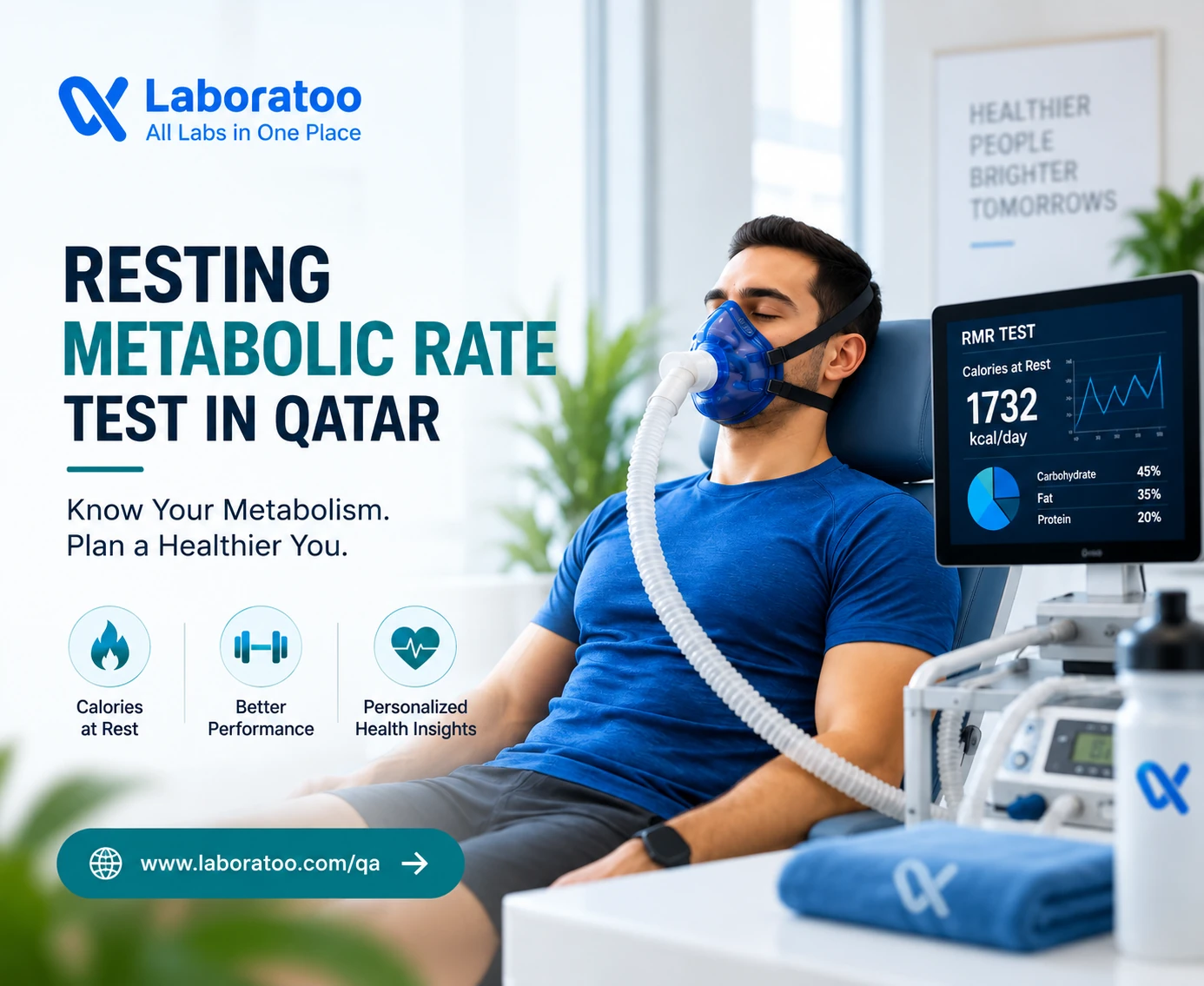
A resting metabolic rate (RMR) test in Qatar can provide a more personalized measurement by assessing how much energy your body uses while you are at rest.
What Is a Resting Metabolic Rate Test?
Your resting metabolic rate, or RMR, is the amount of energy your body requires to maintain essential functions while you are resting.
Even when you're not exercising, your body is continuously using energy for functions such as:
- Breathing
- Blood circulation
- Maintaining body temperature
- Supporting organs
- Cell maintenance and repair
- Other essential physiological processes
For many people, resting energy expenditure represents a substantial portion of their total daily energy expenditure. This is why understanding your individual resting metabolic rate can be useful when creating a nutrition, weight-management, or fitness plan.
An RMR test typically uses indirect calorimetry. During the test, you breathe through a mask or mouthpiece while resting. The equipment measures gases involved in respiration, particularly oxygen consumption and carbon dioxide production, and uses this information to estimate your resting energy expenditure.
Instead of relying only on a generic formula, the test provides a measurement based on your body's actual respiratory data under the test conditions.
RMR Test vs. BMR: What's the Difference?
RMR and BMR are closely related, but they are not exactly the same.
Basal metabolic rate (BMR) refers to the energy your body requires under highly controlled basal conditions. BMR testing generally involves stricter preparation and testing conditions.
Resting metabolic rate (RMR) is measured under less restrictive resting conditions and is commonly used in practical nutrition and fitness settings.
You may also see a BMR estimate on a body-composition report, including reports generated by devices such as InBody. That figure is generally calculated using body-composition information and an equation.
A dedicated RMR test, on the other hand, uses respiratory measurements to assess resting energy expenditure.
For someone simply monitoring general fitness, an estimated BMR can be useful. For people who want more individualized information for nutrition or performance planning, an RMR measurement can provide additional insight.
Why Does Your Resting Metabolic Rate Matter?
Knowing your RMR doesn't automatically tell you exactly how many calories you should eat every day. However, it can provide an important starting point for understanding your overall energy requirements.
1. Create a More Personalized Nutrition Plan
Generic calorie calculators use formulas based on factors such as age, height, weight, and sex.
These estimates can be useful, but they don't directly measure your individual resting energy expenditure.
An RMR test can give you a measured value that a qualified nutrition or fitness professional can consider when developing an appropriate nutrition strategy.
2. Support Weight Management
Whether your goal is weight loss, weight maintenance, or weight gain, understanding energy expenditure is important.
If your calorie target is based entirely on a generic calculation, it may not accurately reflect your individual needs.
RMR information can be combined with your activity level, exercise routine, body composition, and nutritional intake to develop a more personalized approach.
3. Help With Weight-Loss Plateaus
A weight-loss plateau can happen for many reasons.
Changes in activity, food intake, body composition, adherence to a nutrition plan, and metabolic adaptation can all play a role.
If you've been consistently following a structured plan but aren't seeing the expected changes, an RMR assessment may provide additional information that can be discussed with a qualified healthcare, nutrition, or fitness professional.
4. Support Sports Performance
Athletes and serious fitness enthusiasts need to balance energy intake with training demands.
An RMR test can be considered alongside other assessments such as:
- VO2 max testing
- Body composition analysis
- Exercise performance testing
- Lactate threshold testing
- Fitness assessments
Together, these measurements can provide a broader picture of your energy requirements and physical performance.
5. Track Changes Over Time
Your resting energy expenditure isn't necessarily fixed throughout your life.
Factors such as changes in body composition, muscle mass, physical activity, age, and prolonged changes in energy intake can influence energy expenditure.
When appropriate, repeated testing can help you and your professional team understand how your measurements change over time.
Who Can Benefit From an RMR Test?
A resting metabolic rate test in Qatar may be worth considering if you:
- Are following a structured weight-management program
- Want a more personalized starting point for calorie planning
- Are an athlete or regular fitness enthusiast
- Are preparing a nutrition plan around a demanding training schedule
- Have experienced a weight-management plateau
- Are interested in understanding your energy expenditure
- Want to combine metabolic information with body-composition testing
An RMR test isn't necessary for everyone. A qualified healthcare, nutrition, or sports professional can help determine whether it is appropriate for your individual goals.
How Is an RMR Test Performed?
The process is generally simple and non-invasive.
Depending on the testing facility and equipment used, you may be asked to:
- Rest quietly before the measurement.
- Sit or lie comfortably.
- Wear a mask or use a mouthpiece connected to the testing equipment.
- Breathe normally while the equipment measures respiratory gases.
- Remain relaxed and as still as possible during the measurement.
- Complete the test, which commonly takes around 20–30 minutes, depending on the equipment and provider.
The exact procedure can vary between providers, so always follow the instructions given by the facility performing your test.
How Should You Prepare for an RMR Test?
Preparation can affect the measurement, so following your provider's instructions is important.
Common preparation recommendations may include:
- Avoid eating for several hours before the test, often overnight.
- Avoid strenuous exercise before testing.
- Avoid caffeine before the assessment.
- Avoid nicotine before the test.
- Get a normal night's sleep.
- Arrive early enough to relax before the measurement.
- Avoid significant physical activity immediately before testing.
Your testing provider may have specific preparation requirements. Always follow the provider's instructions, especially regarding fasting, medication, exercise, and other factors.
RMR Test and InBody Test: Do You Need Both?
An RMR test and an InBody or other body-composition assessment provide different types of information.
An InBody/body-composition assessment can provide information about factors such as:
- Body weight
- Body-fat percentage
- Skeletal muscle mass
- Fat mass
- Body composition distribution
An RMR test focuses on resting energy expenditure through respiratory measurements.
Using both assessments can therefore provide complementary information.
For example, body-composition testing can help you understand what your body is made of, while RMR testing can help assess how much energy your body uses at rest.
RMR Test and VO2 Max: What's the Difference?
RMR and VO2 max are also different assessments.
RMR testing focuses on energy expenditure while resting.
VO2 max testing measures your body's ability to use oxygen during intense exercise and is commonly used to assess aerobic fitness and endurance capacity.
If you're interested in sports performance, these tests can complement each other:
RMR → resting energy expenditure
Body composition → body composition profile
VO2 max → aerobic fitness
Together, they can provide a more complete picture of your fitness and performance.
Where Can You Get an RMR Test in Qatar?
Availability of metabolic testing can vary between healthcare, sports-performance, wellness, and diagnostic providers.
Instead of contacting multiple facilities individually, you can use Laboratoo to explore available testing options in Qatar.
Laboratoo is a healthcare marketplace that helps users compare and book available laboratory, health screening, sports testing, and diagnostic services from participating providers.
You can explore available RMR testing options in Qatar, check the available information, compare options, and book online where the service is available.
Book a Resting Metabolic Rate Test in Qatar
If you're serious about understanding your metabolism and building a more personalized fitness or nutrition plan, an RMR test can be a useful assessment to consider.
Laboratoo helps you compare and book health and sports testing services in Qatar, making it easier to find suitable testing options without having to search through multiple providers individually.
Explore available testing options and book through: Laboratoo Qatar
Final Thoughts
Your metabolism is individual to you, and a number from a generic calorie calculator may not tell the whole story.
A resting metabolic rate test in Qatar can provide a measured assessment of your resting energy expenditure and may be particularly useful for people working toward specific weight-management, nutrition, or sports-performance goals.
RMR testing can be even more useful when considered alongside body-composition and fitness assessments such as InBody and VO2 max testing.
If you're looking for a more personalized approach to understanding your energy needs, speak with a qualified professional and consider whether an RMR test is appropriate for your goals.
Write a Comment